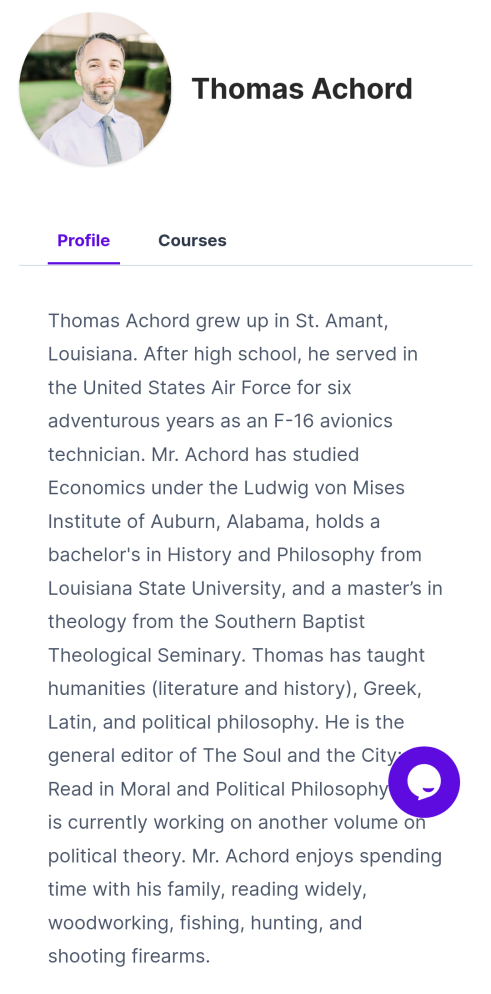
Thomas Achord is the headmaster of a private classical Christian school, the co-author of the 2021 book Who is My Neighbor? An Anthology in Natural Relations, and is co-host of the Ars Politica podcast with Stephen Wolfe, the author of the recent book, The Case for Christian Nationalism. Ars Politica is devoted to Christian political thought and has been running for seventy episodes, and Achord’s public political project is focused on applying his understanding of the Christian political tradition to the present day. Here is his profile:
Of what relevance is Achord? Achord came to my attention initially because of his association with Stephen Wolfe. I cannot know and do not claim to know to what degree if any Wolfe shares what I believe Achord’s views to be. I will here lay out what I believe to be the case about Achord’s views, based on publicly-available information. I do not make any claims about Wolfe’s own. Achord’s work is, in my view, representative of a small but troubling corner of the world that has been broadly called Christian nationalism, and one which I think it would be disastrous to see come to define the movement.
Just a few days ago, Wolfe recommended Who is My Neighbor? as a work by two of his friends. The Kinist IronInk blog describes Who is My Neighbor? as follows: ‘This book is nearly 700 pages long and it provides one quote after another culled from authors (both Christian and Pagan) from Ancient History to modern times, which demonstrate that the doctrines of Kinism have been what all men in all times and in all places have believed.’
More of its contents are laid out in this thread.
Based on my understanding of it, I am firmly opposed to Achord’s political project and to anything like it. This opposition is not coming from someone who is a ‘leftist’. I have been vocal in criticism of mass immigration policies (see this Theopolis conversation, for instance), advocating some views that would be highly objectionable to many. Indeed, Achord favourably quotes statements from me in his book. Nor am I an opponent in principle of Christian nationalism, a position advanced by some of the voices I most admire in political theology and of which, in some form, I myself might reasonably be classed as an advocate.
Rather, my concern is that there is either a stowaway hidden in a specific Christian nationalist project, or perhaps certain projects are functioning as Trojan horses. I fear that Achord is one example of that. I am aiming to bring that to light in hopes of staunching such influences, because I believe it to be a corruption of ideas which I think are very good and important indeed.
There is nothing that would do more to discredit and weaken any Christian nationalist, postliberal, or other similar project than for one of its advocates to be in fact using it as cover for segregationist or white nationalist views. There is nothing that would be more destructive to the movement than to allow it to be so coopted without opposition.
Tulius Aadland
A couple of days ago I posted the following thread, in which I highlighted a tweet thread and a couple of since-deleted articles (one on Faith and Heritage and the other on Identity Dixie) which I attributed to Thomas Achord. I stated that I believed that Thomas Achord was writing under the name ‘Tulius Aadland’. This post provides additional evidence to show that this attribution is well-founded, and that the alternative theory suggested by Thomas Achord that the account was by an ‘imposter’ has, in my view, no basis in reality.
‘Tulius’ argues in the tweet thread I shared that ‘a robust race realist white nationalism can be antifragile regarding cultural Marxism, critical race theory, wokism, BLM, etc.’, drawing strength from those opposing movements.
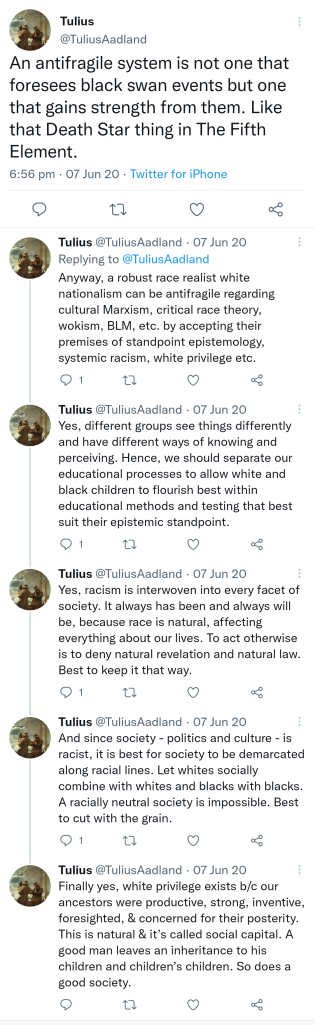
In the second tweet in my thread, I linked to a September 18, 2021 article (the Identity Dixie article which I mentioned above, since deleted by the website) in which ‘Tulius Aadland’ argued for the need for ‘white antifragility’ in response to critical race theory (CRT):
White AntiFragility, using the Counter Dilemma, neither concedes the point nor argues against it. Rather, it deduces another, positive conclusion from the same premises: If your White skin and genes confer the guilt of your ancestors, then they also confer the pride of your ancestors, as well as, their accomplishments, victories, virtues, rights, liberties, freedoms, heritages, lands, and more. Further, if skin and genes confer guilt then this implies that race and blood, kinship and ethnicity bind people together in real, social, national ways that cannot be broken by time or circumstance. CRT, by accusing Whites of racial guilt, reinforces and strengthens ethnic bonds between our ancestors, ourselves, and our posterity.
Achord has, to my knowledge, not denied that he is the author of that article. In his acknowledged Twitter account, he has long been edgy in his posting on Twitter. Although the name is not his own, he doesn’t hide the fact that it is him, nor does he deny it.

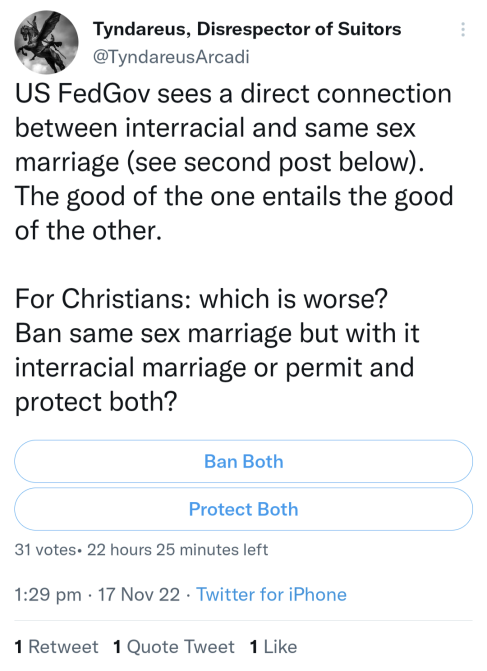
Here are a few representative images from Achord’s main Twitter account from just over the last week (he has changed the handle of his account several times over the last few weeks, but all of them are readily tied to the same account if you search).

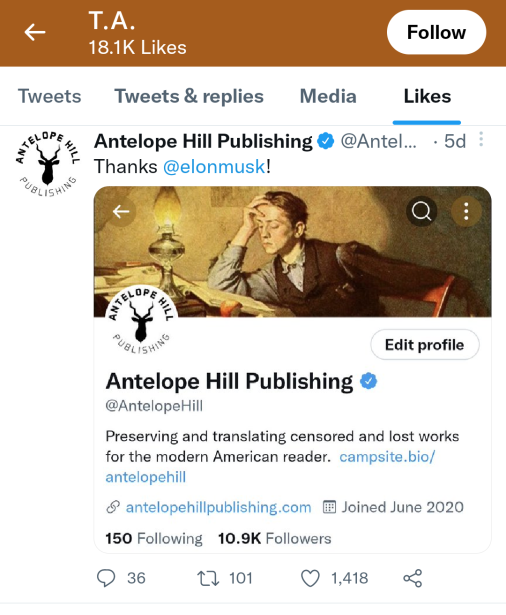
Antelope Hill Publishing is a white nationalist publishing house.
The idea that Achord might have a more obscure account, on which he would be more explicit in expressing sentiments, beliefs, and associations that he insinuates in his more public account was quite plausible. As Achord changed his Twitter name on several occasions over the last few weeks, one of the changes that he made was to ‘Tulius Aadland’.

As his handle was @Tu_Aad, ‘Tulius Aadland’ naturally appeared to be the longer form (the link pictured above appears when searching ‘Tulius Aadland’ on DuckDuckGo). A friend on a theological email discussion list who noticed the name change alerted us to the fact that, when they searched for ‘Tulius Aadland’, the two afore-mentioned articles from white identitarian websites—Faith and Heritage and Identity Dixie—came up.
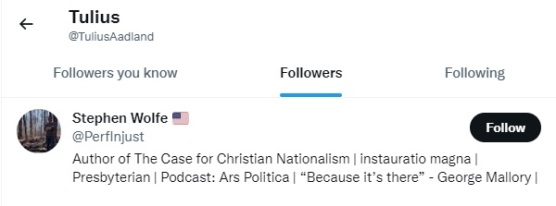
I was curious, and so I searched Twitter for ‘Tulius Aadland’. Only one person came up: @TuliusAadland. Looking at the account, it was immediately evident that it was operating in the same social, cultural, and conversational spaces as Achord. Looking closer, the account, which only had around thirty followers when I first saw it, included among its followers many of Achord’s chief interlocutors, most notable among them Stephen Wolfe (who has subsequently unfollowed the account).
I was also informed of the Tulius Aadland Facebook account. Curious, I looked at the friend list. Of the 27 names I checked, all save two were in Achord’s own friend list. And they weren’t random names either. Once again, Stephen Wolfe was there. Achord’s co-author was there, as was the person who set up the GiveSendGo page for the Achord family, a person who gave an account of meeting up with Achord in person yesterday, and other key individuals. These are all people who should know Achord well and most of whom probably know him personally. Again, when I searched, only one account came up on Facebook under ‘Tulius Aadland’—this isn’t a common name.
The @TuliusAadland account was active between January 1st 2020 and August 27th 2021, with a few hiatuses. We’ll get to those shortly. Over that period, it posted 1,834 tweets. The account’s avi was the same as one of the photos in the Tulius Aadland Facebook account.
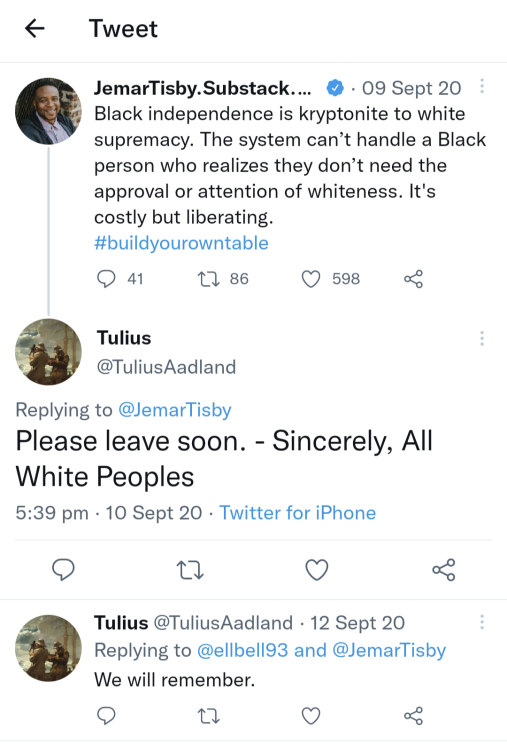
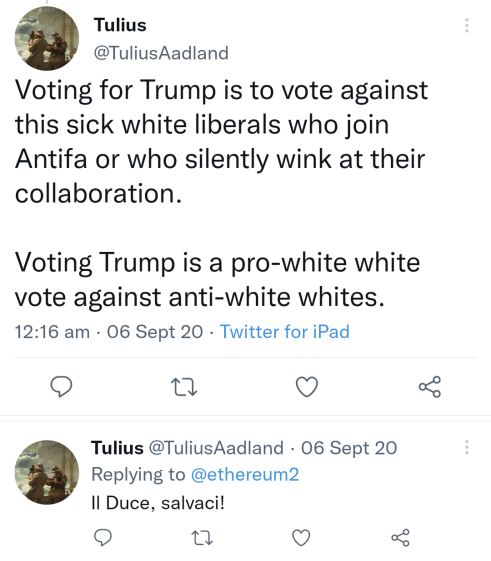
I started to read and search through the @TuliusAadland Twitter account more closely. The shocking character of some of the content was the first thing to strike me. Here is a random selection. Many more examples could be brought forward.


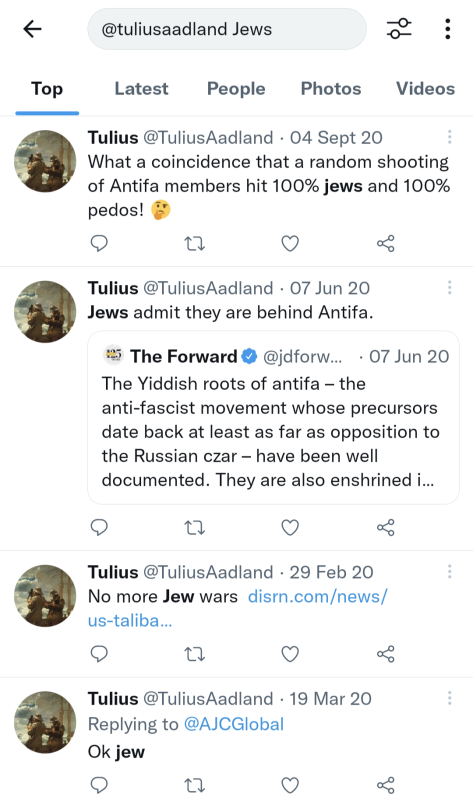
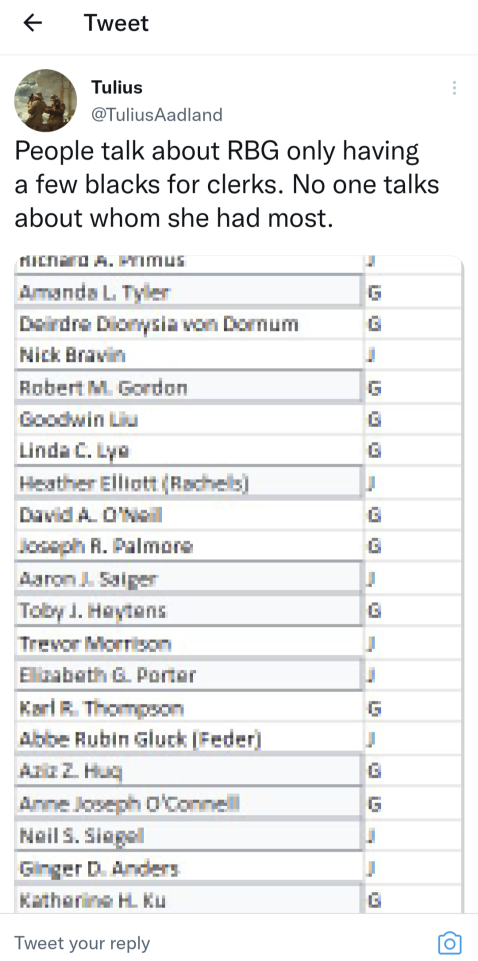

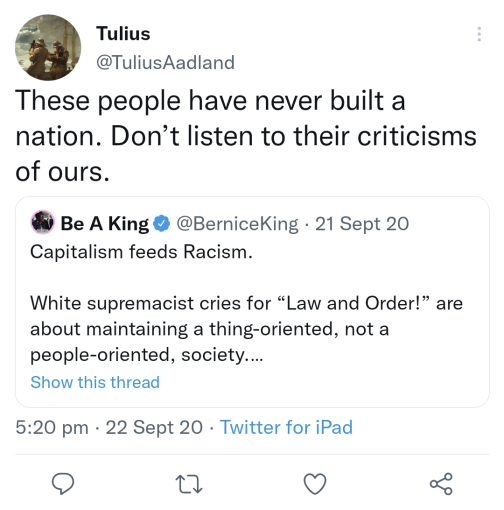
There were also some curious theories about women.
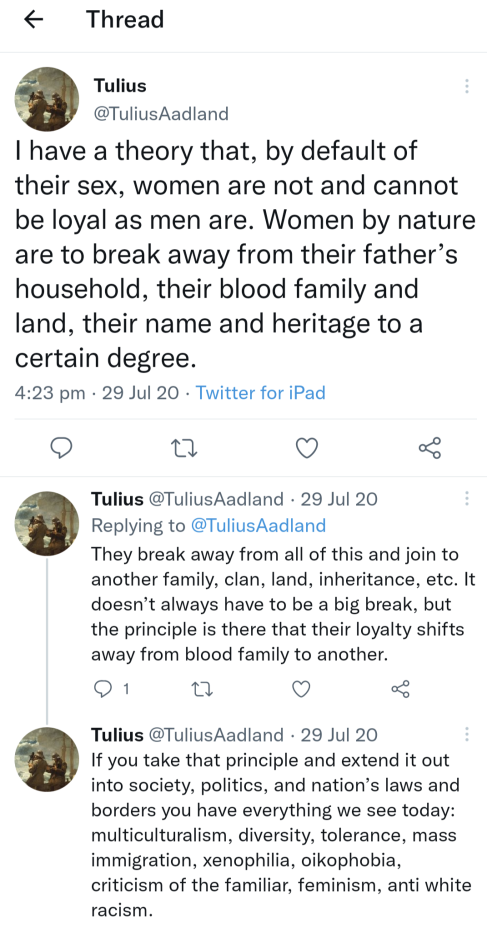
These images, I should stress, are merely a few examples of many that could be brought forward. The account is still online at the time of writing this: you can search for yourself.
In several of the threads, a distinctive voice could be heard, which was very similar to Achord’s own. The antifragile thread, for instance, had a similar argument to the Identity Dixie article, an article which Achord has not denied writing.
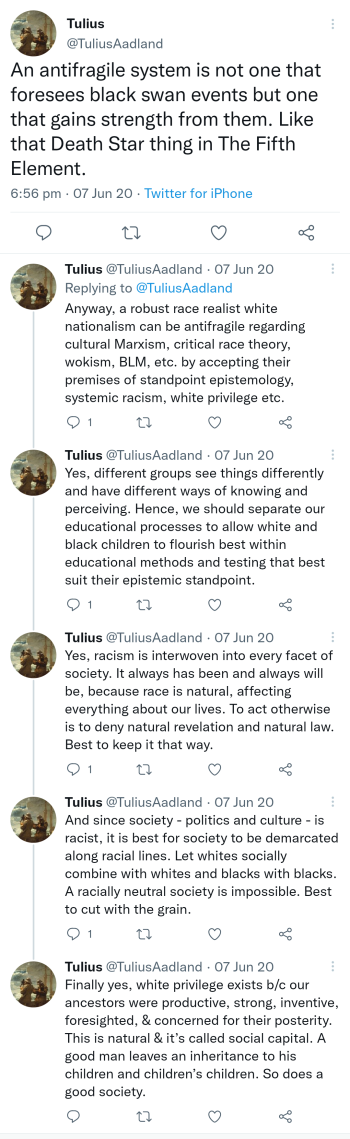
Achord has also used the concept of antifragility on his known account.

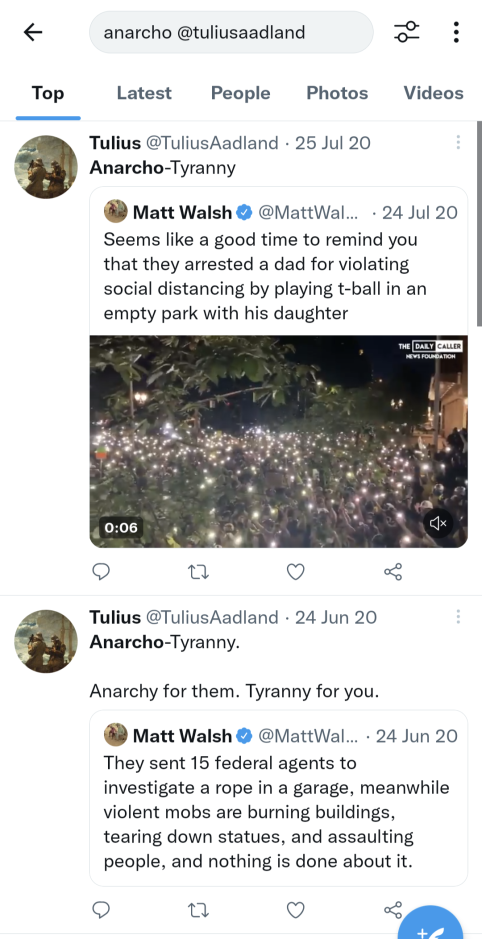
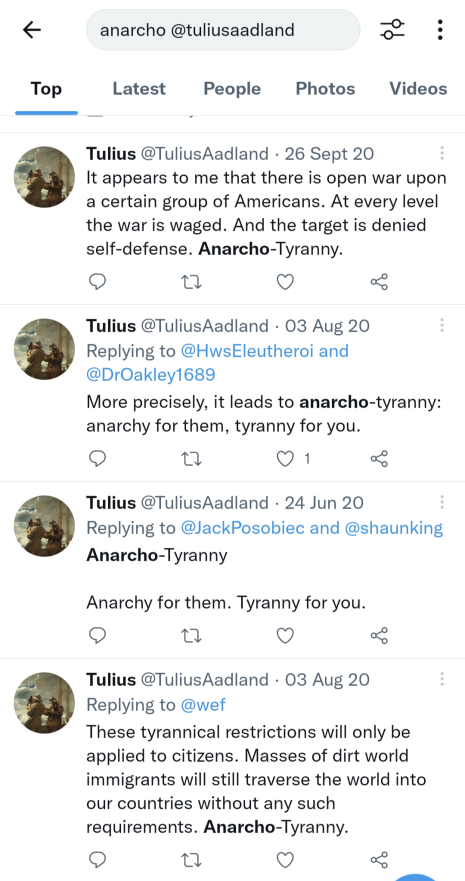
‘Anarcho-tyranny’ has been a crucial concept drawn from Sam Francis for Wolfe and Achord, which can be seen on their podcast and in Wolfe’s writings. It is a concept that they have sought to popularize. Here’s an episode of their podcast on it. Here’s Wolfe on the subject:
There is more to the story of black criminality, but what is important here is that black Americans, considered as a group, are more willing to conduct certain types of public disorder (violence, petty theft, vandalism, looting, rioting, etc.) when constraints are reduced. For this reason, they serve as the anarchic element of anarcho-tyranny in the United States.
Tulius Aadland used the concept on several occasions.
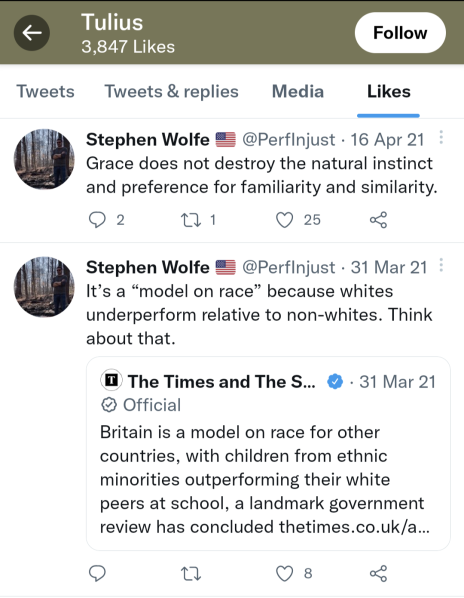
Besides such points of ideological contact, he also engaged with Wolfe on several occasions in likes and tweets.
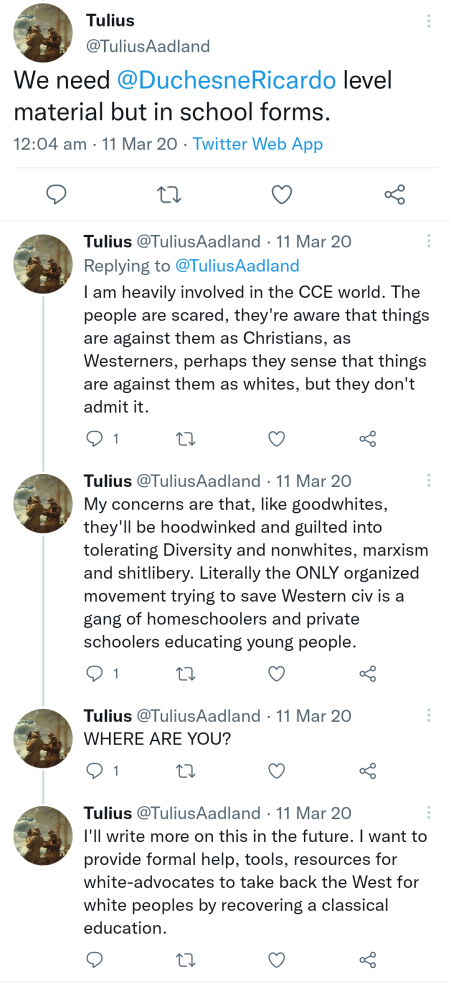
Tulius tweeted the following concerning concerning classical Christian education, which was Achord’s profession.

Achord has always had a distinctive kitschy aesthetic, which the Tulius Aadland account seemed to share (if you look at the accounts it followed) and in some of its tweets. Here is an image from the Tulius Aadland account in September 2020.
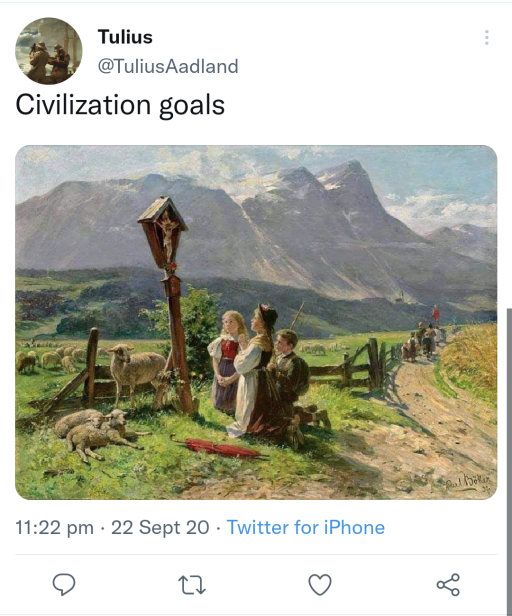
Here is one from Achord’s known account over two years later.
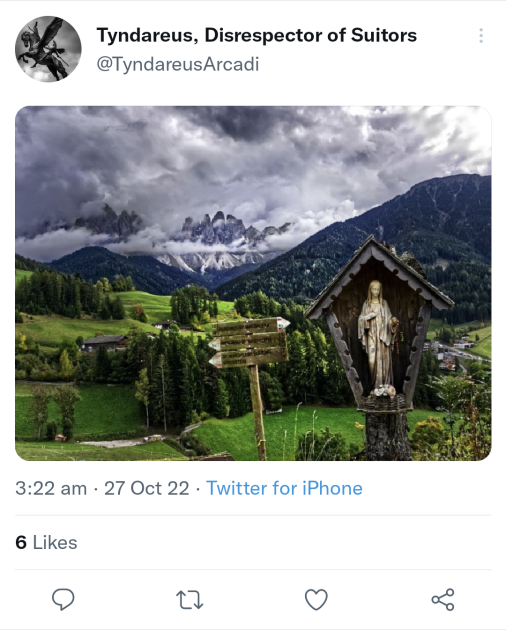
There are other strange coincidences. The Tulius Twitter account retweeted the following tweet.

On August 23rd, the following was posted on Achord’s Instagram. You’ll notice that Achord posted the image either the day that @TuliusAadland retweeted it, or the day after.

Based on these things, I came to the conclusion (the same conclusion that his good friends had come to and been operating under for years) that this was an alt of Achord, and shared the tweets. I thought that it was appropriate (indeed, probably morally obligatory) to bring these things to attention given his sharing in the public project of Christian resourcement, to which I am devoted and to which many institutions I deeply care about are committed. I would not have done so had he been a purely private person or in a role of any less gravity. Again, I was not saying anything new: I was merely drawing attention to what was already publicly on open social media accounts, and naming what all those around him already believed.
Achord’s explanation for all of this is that an impostor was impersonating him. Achord has laid out his side of the story here. He claims that someone was impersonating him on both Twitter and Facebook:
I asked some friends about this, who reminded me that fake accounts, tracking, impersonations, and defamation are ubiquitous on social media, especially Twitter. So, I filed an impersonation complaint with Twitter Support, which responded this time by linking to an associated made-up Facebook page under this same pseudonym, as well as to a few phony email accounts all, again, using this name. I began to wonder what else will emerge! I had no knowledge or access to any of this material, but here it existed, a web of accounts under the name of a pseudonym I once used and which were posting things seemingly on my behalf going back a few years. Furthermore, I have learned now that one of the email accounts, as of yesterday, still had an ongoing conversation with one of my mutual friends who thought he was conversing with me this entire time! Shockingly, it became clear that these fake accounts were created and used over but a short span to parody and slander myself. I immediately petitioned a claim of imposter and defamation claims with these two social media companies, which are currently under investigation.
Notably, he does not deny writing the Faith and Heritage and Identity Dixie articles in this response.
The Problems with Achord’s Theory
Let us remind ourselves of the facts.
- The Tulius Aadland account was running for over a year and a half, posting 1,834 tweets. Neither his Twitter nor Facebook accounts had more than fifty followers. The Twitter account ended over a year ago and, even though so many of his close acquaintances were following it, Achord supposedly only just discovered that it existed.
- The impostor account didn’t use Achord’s real name, but a much less well-known pseudonym. This is a peculiar form of identity theft.
- Achord claims that the alleged impostor accounts were so effective that they fooled many of his closest friends and collaborators.
- The impostor account was exploring the concept of white antifragility in June 2020, something that ‘Tulius Aadland’ wrote about for Identity Dixie in September 2021. Again, note that Achord has not denied writing this article (which, like the other article, was removed by the website).
- By Achord’s account, the Tulius Aadland account was so effective that he claims that he was initially fooled himself. Indeed, he was apparently so convinced that it was his account that he gave an authoritative interpretation of the tweets that I linked. Only later would his story change.

- If Achord’s claims are correct, the account was effective enough to fool Stephen Wolfe, who was following and engaging with it, into believing it to be Achord. If Achord’s claims are true—and even if they are not—how all this reflects upon principles of association in his Christian nationalist circles is a matter that needs to be considered.

- The Tulius account isn’t a troll account, but seriously tries to explore ideas at many points. It voiced opinions on key concepts that interested Achord, from classical Christian education, to political theology, to the military. It engaged with similar people and attacked similar people as Achord’s own account. It had similar kitschy aesthetics.
- If the impostor were intending to defame Achord by voicing hateful views, it is surprising that their accounts so successfully fooled the people who knew Achord best into thinking that they contained Achord’s actual opinions. Nothing jarred with them when their close and trusted friend was spewing the most hateful racial vitriol?
The claims of Rubatirabbit’s thread in defence of the impostor theory are readily answered or dismissed (not least because many differ from Achord’s own later claims). Rubatirabbit wrote: ‘if there was a far rightist who frequents conservative/right wing circles which Achord frequents, he may have encountered one variation of Tulius Aadland, and since Tulius is the name of a Roman king, and Aadland sounds cool and Nordic, such a person may have adopted it.’
There are many cool names and handles out there, but stealing an appealing pseudonym and writing articles almost three years apart under that stolen pseudonym is odd practice indeed. And ‘Tulius Aadland’ hardly has anything peculiar to commend it.
Rubatirabbit draws attention to the birthdate of the Tulius Aadland Facebook account (the one almost entirely followed by Achord’s close friends), claiming that it clearly isn’t Achord’s birthdate. As the Tulius Aadland Twitter account mentions the author’s past experience in grad school, it probably isn’t his birthdate either. We’ve already established that ‘Tulius Aadland’ isn’t his real name, so should we be surprised that he didn’t give Facebook his actual birthdate either?
Rubatirabbit identifies his ‘strongest argument’ as the following:
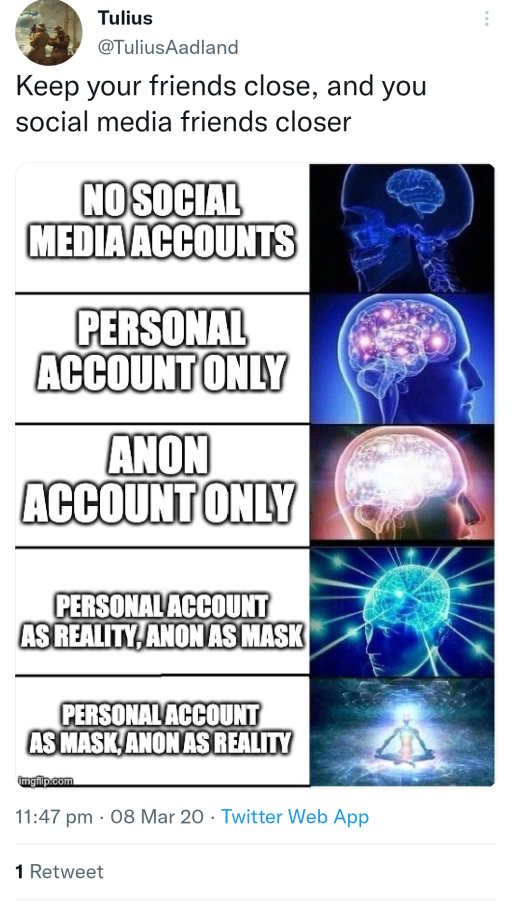
Achord uses the Tulius Aadland Pseudonym on HIS MAIN ACCOUNT. There is no logic, or reason, for him to create another account using *the exact same pseudonym*. What would be the sense or logic of such a move?
I think a lack of sense and logic might be explanatory factors in various actions in this case. Besides, here is the Tulius account.
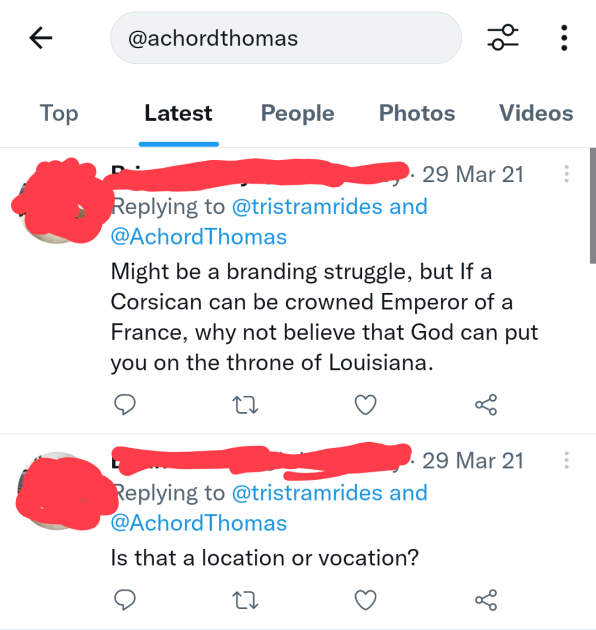
It is worth bearing in mind that Achord had yet another account, @AchordThomas, which was just reactivated a few days ago and has yet to tweet anything. However, if you search for @AchordThomas you can see lots of tweets interacting with it, from known friends, associates, and acquaintances of Achord. However, the interactions end on March 29th 2021.
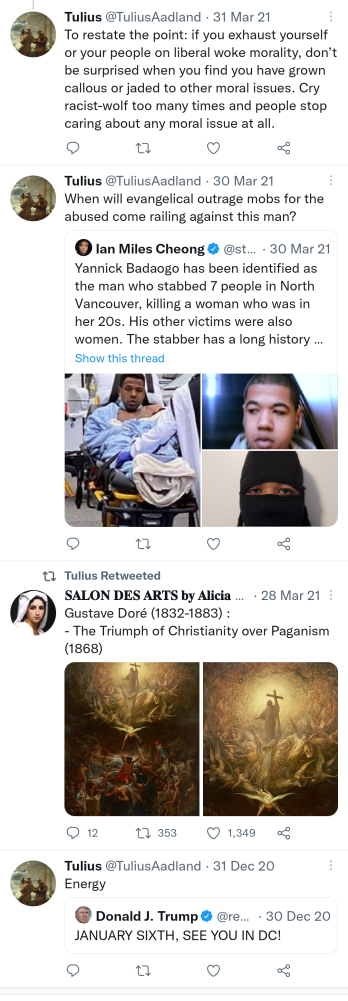
If you scroll through down through the timeline of the @TuliusAadland account you should notice something interesting: a long gap in activity between the end of December 2020 and the end of March 2021.
Rubatirabbit wonders why, if the account is truly Achord’s, it has not yet been scrubbed. One might speculate that scrubbing the account might be incriminating. However, there is also the genuine possibility that a person with a dozen or so social media accounts under his real name and various pseudonyms and several burner email addresses might just have lost the login details.
Is this all the information supporting the identification of Thomas Achord as the author of the Tulius Aadland account?
No. Rod Dreher, whose wife taught at the school, highlighted the following tweet:

Note the symbol on the door. It is the same as the symbol of the church in whose building Sequitur Classical Academy, Achord’s school, operated.

Rod Dreher has laid out this line of evidence here. The timeline is important here: at the time the photo was taken (mid-February 2020), Achord was not yet the headmaster of the school, weakening any case that it was produced by anyone in the community seeking to attack or discredit him.
We have a choice here. Either we are to believe Achord’s claims that an impostor was actively running accounts under one of his pseudonyms for nearly two years, which attracted many of his close friends and associates, with whom the impostor interacted both publicly and privately. That these close friends and associates might all independently(?) connect with active impostor accounts, yet the fact that there were two active impostor accounts would never be brought to Achord’s own attention. That these accounts were a determined effect to ‘parody and slander’ him (using his obscure pseudonym rather than his actual name), yet have only just come to light, nearly three years after they were first created, and that he himself wasn’t aware of them until a few days ago. That while he utterly deplores the sentiments of the racist tweets, the account successfully fooled several of his closest friends and collaborators that it was expressing his true sentiments. That Achord is free of such racist views, yet many of his closest friends and associates would not take issue with a collaborator expressing such positions, feel that such opinions jeopardized their common cause, or be surprised enough by such viewpoints being expressed in his name that they would bring such a matter up with him, alerting him to the fact that an impostor was acting under his identity. That the impostor was so close to him that they were sharing pictures from within the building where his school operated.
Alternatively, we could believe that a person who has publicly expressed sentiments most would deem racist and is known to operate multiple Twitter accounts and identities also had a private account in which he expressed hateful views more freely with his close friends, who tolerate and perhaps share them. And that, when caught out, he tried to cover it up.
Responses
The case that @TuliusAadland is Thomas Achord is straightforward and based on compelling cumulative evidence. The counterarguments are embarrassing. However, the questions that the whole affair raises are extremely damaging, not just for Thomas Achord, but also for close associates and collaborators with far greater influence. If the expression of the views of ‘Tulius Aadland’ were tolerated by persons at the heart of a rising Christian nationalist movement, and not regarded as utterly inconsistent with the enjoyment of a public voice in their cause, it raises grave concerns about the health of such a movement more generally. If such a person could see their racist interests so advanced by the movement that they would put themselves forward as leading champions of it, that also raises questions about the movement and its ideology. Whether he was a stowaway—his true beliefs hidden from his companions—or whether the form of Christian nationalist ideology he publicly advocated and some of his leading fellow advocates provided cover for his true views, we face disquieting questions.
The evidence I am relying on in this post is all publicly available. It could be further supported by extensive evidence from private contexts and supporting testimony, which I am for obvious reasons not at liberty to share.
At this point, I should also make it clear that I did not contact Achord’s school and Achord’s school did not contact me. I made no association between Achord and his role in the school in my thread nor in any subsequent online conversations prior to receiving news of his firing/resignation (he describes it as the latter). I only addressed Achord as a public voice of a certain form of Christian nationalism.
I have no driving desire to deplatform people and strip fellow Christians of their livelihoods. I do not want to see Achord and his family immiserated, and in fact, if you feel led to do so, you can support them here. Please also pray for their well-being, as I have done and continue to do. However, I do not want to see Achord accepted as a wise voice in Christian political discourse. I do not want to see him forming the minds of the young or old. More broadly, I want us to be far more careful in protecting our churches, movements, and institutions from both dangerous ‘stowaways’ that could easily destroy movements and institutions, and versions of Christian nationalism which contain insufficient guardrails to prevent such co-opting and subversion—which would render any movement so co-opted as not just destructive but utterly politically ineffective.
Conclusion
My conclusion that @TuliusAadland is Thomas Achord seems to me irrefutable. If somehow I am given good reasons to believe that I’m wrong, I will be very willing, on pain of ninth commandment violation, to say so. But if I am right, Achord, a published author and podcaster, with a public voice in a developing Christian nationalist movement, is providing cover for and even spreading racist and other profoundly objectionable views. If I am right, Achord has brazenly lied and he and others have made extremely damaging claims and insinuations about my actions in order to cover up his own.
I reached these conclusions carefully and made the decision to publish them in consultation with people I trust. I delayed this statement and presentation of evidence to provide the considered, sober, and thorough handling that matters of this severity and consequence demand. Our speech on matters of such weight must neither be impelled by the heat of our passion nor driven by the impatient demands of the Internet. In such situations, there are much more important things at stake than petty personal beefs, points scoring, or even a selfish preoccupation with our own reputations and social standing. Publicly made allegations should be backed up with public presentation of evidence, but the more compelling character of the case presented later in Proverbs 18:17 may not be accidental to the proverb’s import: haste is not a virtue in such matters.
The views expressed in the tweets are not, in my view, inconsistent with Achord’s public views, though they are expressed more crudely, and he has given us little reason to think that he disagrees with those views; again, to my knowledge he did not even deny writing the articles. And in fact, again, his initial move was not to deny that @TuliusAadland was him, but to claim that the thread I posted was a reductio and that I should have gotten in direct contact if I wanted to know about them. How was I meant to get in contact with the author if it was not him?
Tellingly, many of the responses from the Christian nationalist rank and file have been more concerned about the revelation of the identity of the author of racist tweets, rather than the sentiments themselves.
On the other hand, in this masks-off moment, it has also been extremely clear that most leading voices in the Christian right will make no compromise with racism. Neil Shenvi in particular has my extreme admiration and appreciation for the way that he put his own reputation on the line in sharing and standing by my thread. Brad Littlejohn has also been an immense encouragement and support. For me, Brad has long exemplified what a thoughtful and healthy American Christian nationalism should aspire to be. The organizations with which I am affiliated, the Davenant and Theopolis Institutes, have been a boon and a blessing at a time when it is difficult to know who your friends are.
Many of mine are Christian nationalists who uncompromisingly resist the racism that can be seen in the Tulius account. Much of my determination in challenging the influence of people like Achord has arisen from my concern that they are corrupting and undermining the reputation and character of institutions and movements about whose ministries, visions, and members I care deeply. I think this movement is too important to allow that to happen—to allow it to be tarnished by such things.
Many who oppose us believe Christian nationalism—indeed, any kind of retrieval or renewal of the great Christian and Classical traditions that shaped the West—to be nothing more than a fig-leaf for white supremacism. To the best of my ability, I will not allow that to be the case on my watch. Accusations are nothing. What we are responsible for is making sure that they are not true. What we are responsible is standing for, and fighting for, an intellectual and social world that is real and sane and whole and good.
What are we to make of this? Should we run from anyone who claims to want to “renew Western civilization?” Certainly not. Is it the case that any project that Achord was involved in is entirely tainted? It is not. Things must be evaluated on their own merits.
My initial attention to Achord was drawn by his association with Stephen Wolfe. As I said before, I do not and cannot know what Wolfe’s views on these things are. I do, however, think that his book is a radical misuse of the tradition which he is working in, although it can be a gateway to some of these thinkers and serve as a sort of bibliography of Classical and Christian political sources. To begin to learn how to navigate the world he presents in his book in what I believe to be a far richer and more responsible manner, I would recommend that you start with my wife Susannah’s superb recent Theopolis article in response to Wolfe.
I have put an awful lot of my reputational capital on the line in all of this. There are few self-interested motives for me to be involved in any of this.
But I am as I write this deeply hopeful because of the the host of people who have written in support, have helped, who share my desire to promote Classical and Christian retrieval in and for our time, and do not think that this entails ethnic or racial separatism or hostility: who have a broader vision and love the tradition for what it is, not for the use that can be made of it. Ultimately, those of the Christian retrieval/postliberal/what-have-you movement who are driven by racial animus are a small minority. There is a lot to do, and there are many comrades with whom to do it. We need each other in this work.
There is very good news here. We do not need to choose between a love of the tradition and a robust affirmation of the very concrete and practical brotherhood in Christ that is between Christians of different ethnicities. Both the Classical and Christian traditions themselves overturn the need for ethnically or racially separate friendships, churches, and, yes, countries.
It seems that Achord was once driven by the desire to do Classical and Christian retrieval himself, before he was so horrifically derailed. That is a good desire. If we are to renew Christendom it cannot be on the back of a narrow racialism. That racialism is not faithful to the fullness of our own traditions and it is, moreover, utterly destructive of any possible form of political action. To cling to racialist hostility is to make oneself politically neutered, irrelevant; it is to halt any constructive action.
But ultimately, our concern must be the name of Christ. It is for his glory and the well-being of his Church, his beloved Bride, made up of men and women of all nations and races and ethnicities, in which the dividing line of hostility has been broken down, that we must act. It is her we must protect. Let us uncompromisingly root out anything that would undermine this.
O God who art the author of peace and lover of concord, in knowledge of whom standeth our eternal life, whose service is perfect freedom; Defend us thy humble servants in all assaults of our enemies that we, surely trusting in thy defence may not fear the power of any adversaries, through the might of Jesus Christ our Lord. Amen.

 A two part piece of mine was recently published over on The Biblical Mind. Within it, I explore what it means to read the Law with wisdom, focusing upon the fourth commandment, concerning the Sabbath. I show that the import of the core commandment is discovered in the extensive expansion of its principle in history, covenant, feast, and broader legal material. Read part 1

 I wrote a




 Alastair's Adversaria